Children are alive today because of shared data.
The Pediatric Cancer Data Commons (PCDC) is helping doctors and researchers around the world save lives by making it possible to study childhood cancers faster, smarter, and at a truly global scale.
One of the earliest examples of how data sharing helps children with cancer was the development of a global standard for neuroblastoma risk stratification. This means that doctors now know which children are at the highest risk, and which ones can avoid unnecessary treatment while still achieving excellent outcomes. For children with neuroblastoma, that means improving both survival and quality of life.
By bringing together high-quality clinical data (information gathered during patient care – like treatment details, symptoms, lab results, images, and more), the PCDC is accelerating discoveries and getting breakthroughs into the clinic sooner—where they matter most.
Every data point in the PCDC represents a patient, a family, and a story, where compassion and science meet.
What Is The Pediatric Cancer Data Commons?
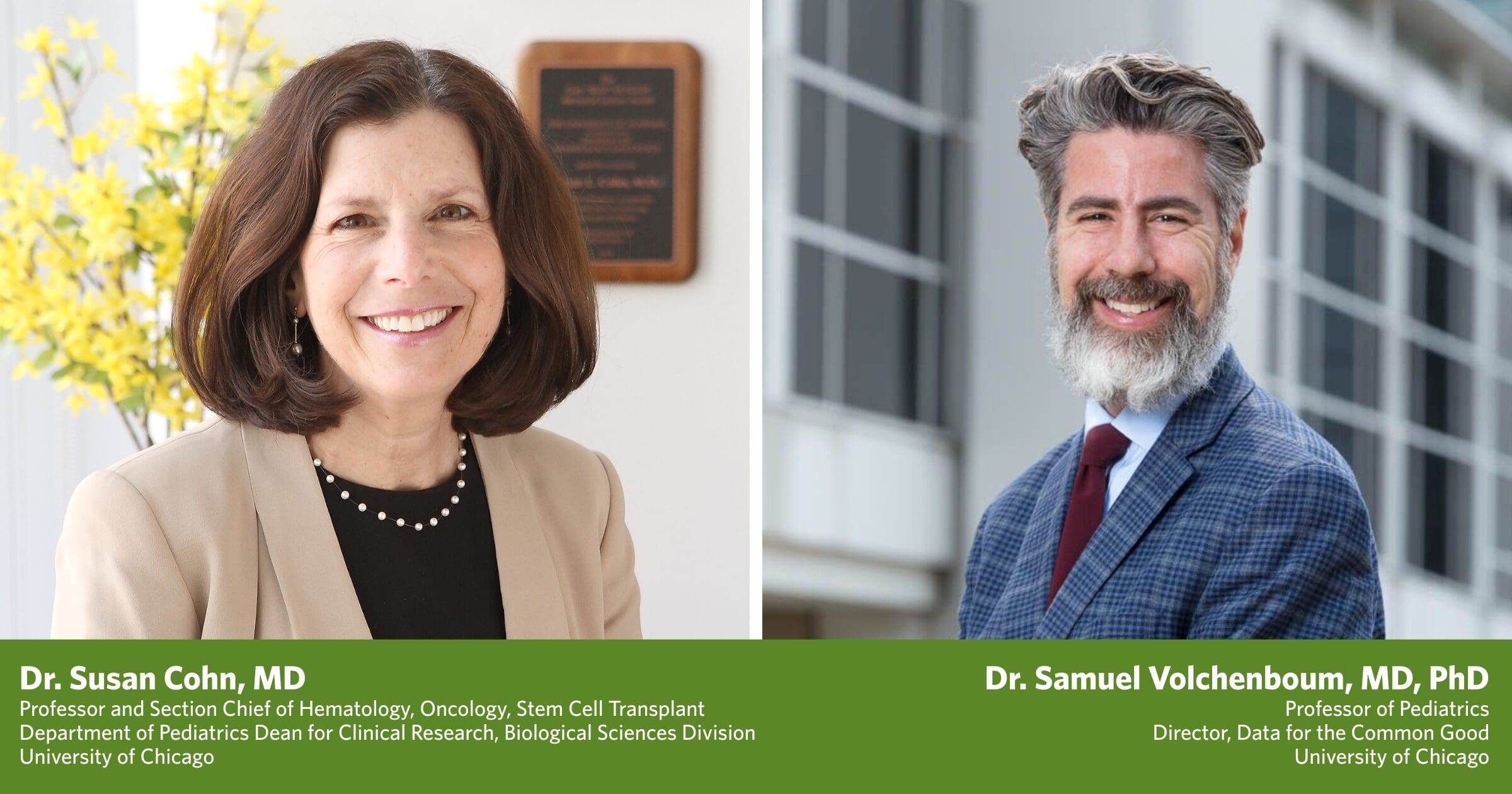
The Pediatric Cancer Data Commons (PCDC) is a global, unified research platform that brings together high-quality clinical data from children, adolescents, young adults, and adults with cancer. It is the flagship initiative of Data for the Common Good at the University of Chicago and was launched in 2016 by Drs. Susan Cohn and Samuel Volchenboum.
At its core, the PCDC addresses a critical gap in pediatric cancer research: the lack of rapid, large-scale, high-quality data sharing.
Childhood cancers are rare, and individual institutions often see too few patients to identify patterns or test new approaches efficiently. By harmonizing clinical data across institutions and countries, the PCDC enables researchers to see a fuller picture – accelerating discovery and bringing research breakthroughs to clinicians faster.
For each cancer type, the PCDC team helps the research community to develop a shared data dictionary, allowing data from many sources to be standardized and meaningfully compared. Today, the PCDC includes data for 13 childhood cancer types, with contributions from 47 institutions in 28 countries across six continents – totaling data on over 46,000 children and young adults.
How Shared Data Drives Breakthroughs
Beyond individual diseases, shared data enables researchers to:
- Recognize patterns faster
- Design smarter studies and clinical trials
- Ask better questions about diagnosis, outcomes, and survivorship
- Ensure ultra-rare cancers and conditions are not left out of discovery
- Facilitate the inclusion and study of a diverse population of patients
Breakthroughs often emerge when scientists look across diseases, not just within them. Insights from research on conditions such as Down syndrome and congenital heart defects have informed leukemia research – demonstrating how shared data can spark progress far beyond a single diagnosis.
The Role of St. Baldrick’s Foundation
St. Baldrick’s Foundation was the first major supporter of this initiative, funding the project from its earliest days as a simple neuroblastoma database through its evolution into the Pediatric Cancer Data Commons. This early and sustained investment helped transform an innovative idea into a global research infrastructure that now serves the entire pediatric cancer community.
“St. Baldrick’s Foundation supported our data commons work at the ground floor, a full decade ago, when its potential was still largely aspirational. Their early funding made the effort possible and laid the foundation for everything that followed. Much of our scientific and funding success in pediatric cancer traces directly back to that initial vote of confidence.”
Samuel Volchenboum, MD, PhD
Professor of Pediatrics
Director, Data for the Common Good
University of Chicago
The shared goal is clear: a world where access to high-quality data is never a barrier to saving a child’s life.