Three new St. Baldrick’s research grants, made possible by Allied World’s five-year commitment, aim to improve the health and quality of life of kids with cancer during treatment and beyond.
Surviving childhood cancer is a major milestone. But for many kids, the challenges don’t end when treatment does.
Cancer treatments can leave lasting effects on a child’s heart, physical health, and overall well-being. And for kids still undergoing treatment, side effects can make everyday activities — like playing sports, doing schoolwork or simply keeping up with other kids — more difficult.
That’s why childhood cancer research isn’t just about finding cures. It’s also about helping kids live healthier, fuller lives during treatment and long after.
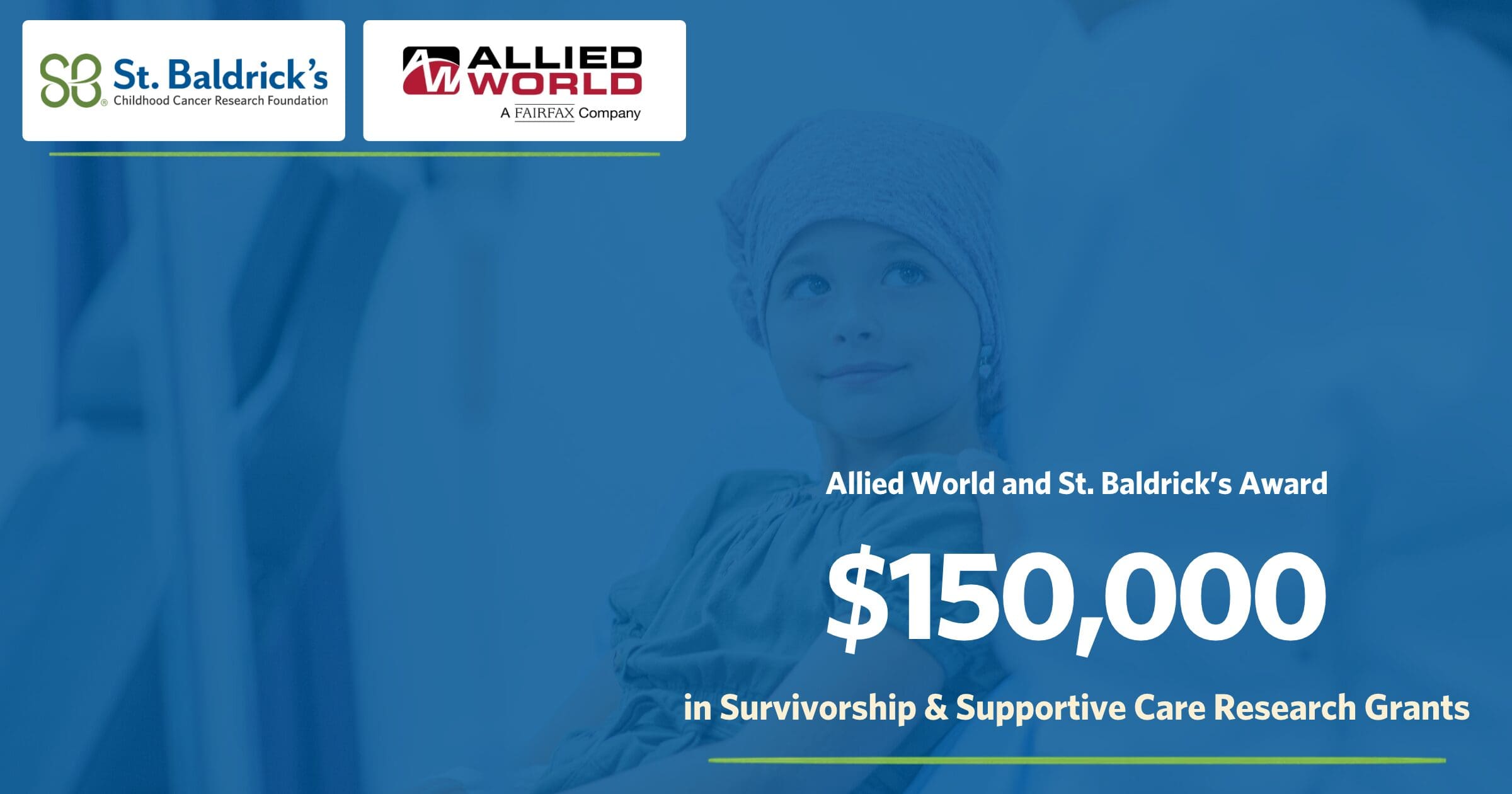
Now, thanks to a partnership between Allied World and the St. Baldrick’s Foundation, three new research grants totaling $150,000 will help address these challenges — marking the return of an important research funding program that had been on pause for years.
Bringing Back Critical Childhood Cancer Research Funding
In March 2026, Allied World announced a $4.3 million, five-year commitment to St. Baldrick’s to advance childhood cancer research. A key part of that commitment was reopening the Foundation’s Survivorship and Supportive Care Research Grant Program, which had been paused since the COVID-19 pandemic.
Today, that commitment is delivering on its promise.
Through the Allied World – St. Baldrick’s Survivorship and Supportive Care Research Grant Program, three researchers have received funding to investigate challenges that can affect children during cancer treatment and throughout survivorship.
Their work addresses an important question: How can we help children not only survive cancer, but stay healthier during treatment and in the years that follow?
Meet the Researchers Behind Three New Survivorship and Supportive Care Grants
From building healthy habits during leukemia treatment to protecting survivors’ hearts, these newly funded studies are exploring ways to improve life for kids affected by cancer.
Helping Teens with Leukemia Stay Active During Treatment
Dr. Brittany Ivory | Children’s Hospital Los Angeles
Imagine being a teenager who wants to stay active, but cancer treatment leaves you feeling too tired or weak to participate in the activities you love.
For teens undergoing leukemia treatment, fatigue and weakness can lead to long periods of inactivity, increasing their risk of health problems like heart disease and diabetes later in life.
Dr. Brittany Ivory, at Children’s Hospital Los Angeles, is studying ways to help change that.
Her research is testing an enhanced program called ReSeT2, designed to encourage teens to stay active during treatment through personalized health coaching, support from peers, home exercise equipment, and rewards for reaching activity goals.
The hope is that helping teens build healthy habits now will improve their physical health and well-being for years to come.
Understanding the Long-Term Effects of CAR T-Cell Therapy
Dr. Liora Schultz | Columbia University
CAR T-cell therapy has offered new hope to children with leukemia, including some whose cancer hasn’t responded to other treatments.
But because this innovative treatment is relatively new, researchers are still learning about its long-term effects.
Dr. Liora Schultz, at Columbia University, is working to change that by studying the health of children who have received CAR T-cell therapy.
Her research will examine potential complications, including infections, organ problems, and challenges that affect daily life.
By identifying which children may be at greater risk for long-term health problems, her work could help doctors provide more personalized follow-up care and better support survivors as they grow.
Protecting the Heart Health of Childhood Cancer Survivors
Dr. Olga H. Toro-Salazar | Vanderbilt Health
Some childhood cancer treatments can affect the heart, putting survivors at increased risk for serious health problems later in life.
Could an at-home exercise program help childhood cancer survivors build healthier hearts?
That’s what Dr. Olga H. Toro-Salazar at Vanderbilt Health hopes to learn.
Her study is evaluating EX@HOME, a 16-week exercise program that combines a mobile app, wearable fitness watch, and personalized coaching to help childhood cancer survivors safely improve their fitness and heart health.
The goal is to develop a more accessible way for survivors to build strength, stay active, and potentially reduce their risk of future health complications.
Why Childhood Cancer Survivorship Research Matters
Today, across all types of childhood cancer combined, approximately 4 in 5 children diagnosed in the U.S. survive. That’s tremendous progress, made possible through decades of research.
But as more children survive cancer, understanding and addressing the long-term effects of treatment becomes increasingly important.
Survivorship and supportive care research helps doctors find ways to prevent complications, manage side effects, and improve care for children both during and after treatment.
A Partnership Making More Childhood Cancer Research Possible
These three new grants mark another important milestone in Allied World’s five-year commitment to St. Baldrick’s.
Earlier this year, that same commitment funded the entire 2026 class of eight Allied World – St. Baldrick’s Fellows, supporting early-career physician-scientists working to improve treatments and outcomes for children with cancer.
Now, with the return of survivorship and supportive care research funding, the partnership is helping address another critical need in childhood cancer research.
Because conquering kids’ cancer means more than finding cures. It means giving children the best possible chance to enjoy everything childhood — and the years beyond — have to offer.
Thanks to Allied World’s support, St. Baldrick’s can continue investing in research that makes that future possible.
You can help, too.
Donate today to support lifesaving childhood cancer research.