Six years ago, a bold research project started with the potential to change how Ewing sarcoma is treated. Today, we’re excited to share just how far that research has come.
In 2019, a generous $1 million anonymous gift to the St. Baldrick’s Foundation launched the Martha’s Better Ewing Sarcoma Treatment (BEST) Grant for All, a special funding opportunity created to inspire bold new ideas for treating Ewing sarcoma—a rare and aggressive bone cancer that most often affects children and young adults.
Named in honor of Martha, a remarkable teenager who bravely battled Ewing sarcoma, the grant was established with one goal in mind: to find better treatments and improve outcomes for children facing this devastating disease.
More than 40 researchers answered the call, and after a rigorous scientific review, Dr. Poul Sorensen, at the University of British Columbia, and his team were selected to pursue an innovative new approach.
Missed the original story? Read how the Martha’s BEST Grant helped launch this promising research.
From Discovery to Potential Treatment
When this research began, Dr. Sorensen’s team identified a protein called IL1RAP that appears in high amounts on the surface of Ewing sarcoma cells but has very limited presence on healthy tissues. That made it an ideal target like a beacon that helps distinguish cancer cells from healthy ones.
The team’s goal was ambitious: create a therapy that could recognize this target, deliver cancer-fighting medicine directly to the tumor cells, and spare as much healthy tissue as possible.
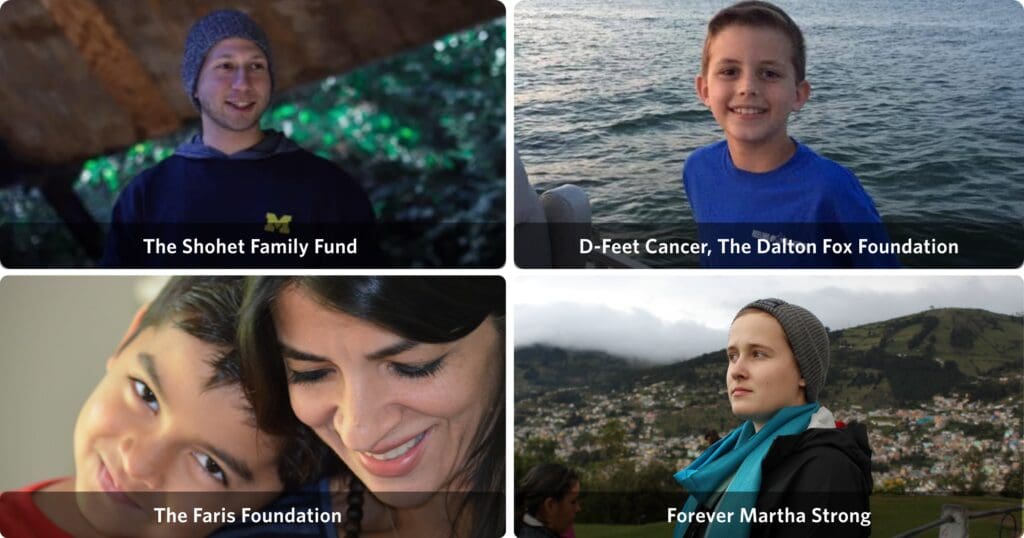
Early findings were so encouraging that the original anonymous donor renewed their commitment to this work. They were joined by D-Feet Cancer, The Faris Foundation, The Shohet Family Fund for Ewing Sarcoma Research, and Martha’s family, to fund the critical final studies needed before a clinical trial could begin.
Together, their support enabled Dr. Sorensen’s team to expand testing of the therapy, evaluate how it could work alongside current chemotherapy treatments, and complete additional rigorous safety and pharmacokinetic studies required before bringing this approach closer to children with Ewing sarcoma.
The Results Are In
Thanks to that continued investment, Dr. Sorensen’s team has now published exciting new findings demonstrating just how promising this approach may be.
The researchers successfully developed an antibody-drug conjugate (ADC) designed to seek out and bind IL1RAP on Ewing sarcoma cells and deliver a powerful anti-cancer drug directly to them. Think of it as a guided delivery system—one that helps target cancer cells while limiting exposure to healthy cells.
In preclinical studies, the IL1RAP-targeting therapy:
- Blocked tumor growth.
- Caused tumors to shrink, with durable responses.
- Dramatically reduced the spread of cancer to other parts of the body.
- Showed little if any evidence of harm to healthy tissues, including in safety studies.
Even more encouraging, the researchers found that IL1RAP is also expressed in several other cancers driven by similar genetic changes. While additional research is needed, these findings suggest this approach could eventually have applications beyond Ewing sarcoma.
Looking Ahead
While more work remains before this therapy can be tested in children through a clinical trial, the publication of these findings marks an important milestone. The research has progressed from identifying a promising target to developing and validating a targeted treatment approach with very encouraging preclinical results.
This journey—from a bold idea funded through the Martha’s BEST Grant, to continued investment from dedicated families and funding partners, to promising published results—shows what is possible when researchers, donors, and families come together with a shared goal: to create better treatments for kids with cancer.
Every breakthrough begins with an idea. But turning that idea into a treatment that can help children requires years of research, collaboration, and support.
At St. Baldrick’s Foundation, we believe every child deserves the best chance at a cure. With the support of our community, we can continue funding the innovative research that brings us closer to that future.
Help support the next breakthrough in childhood cancer research. Donate today and join the fight to conquer kids’ cancer.